When a habit isn’t sticking, Monius changes the habit.
Most trackers record the days you missed and leave the goal where it was. Every Sunday, Monius looks at the week you actually had and offers one change per habit — ease what’s too much, raise what’s going well, rest what needs a break. One tap applies it.
iPhone · iOS 26 or later Free for a week · Pay once · No account
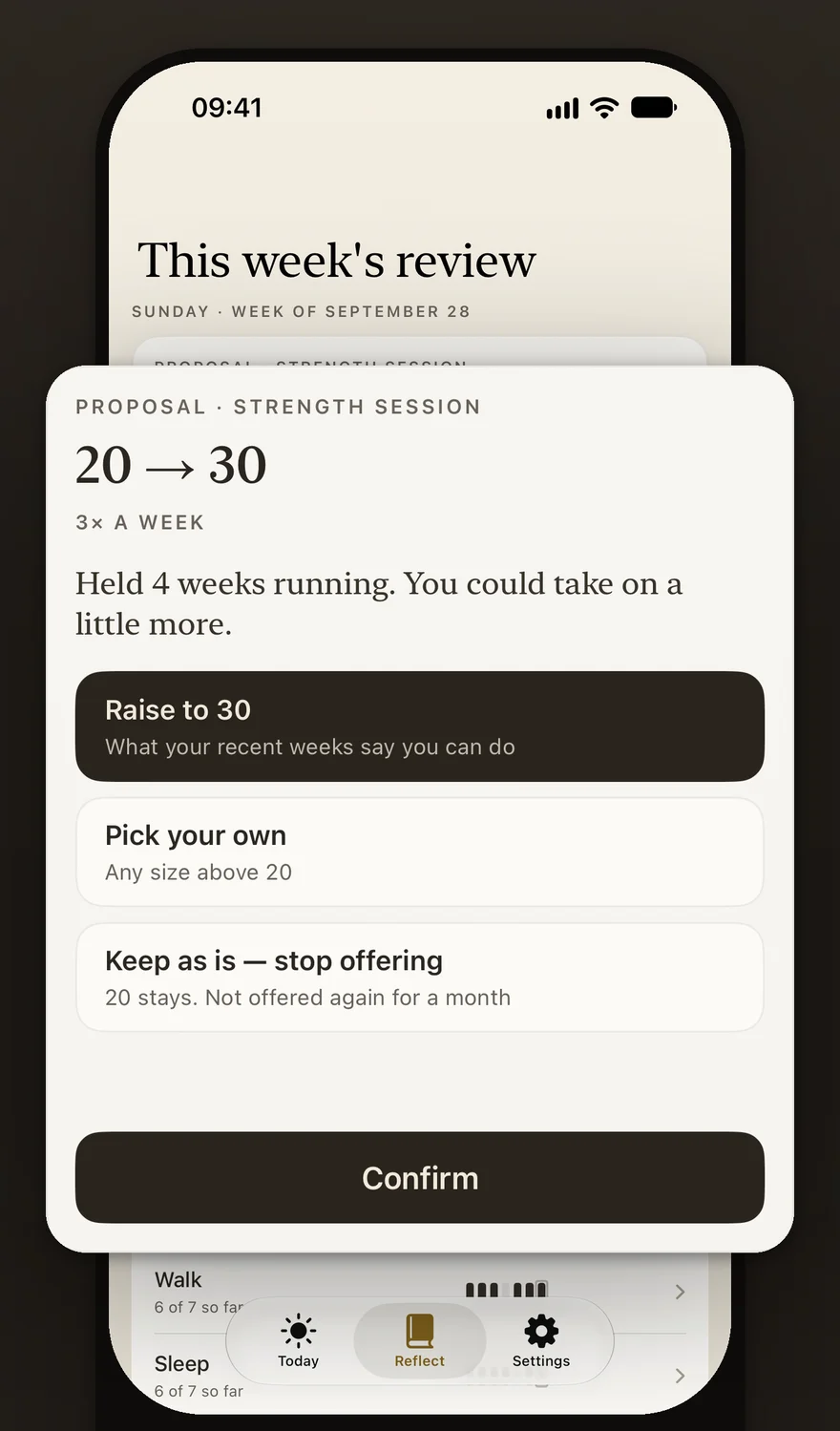
Too much? It eases. Going well? It raises.
On Sunday, Monius reads the week you actually had and offers at most one change per habit. Each proposal is a card with a number on it — “Raise to 10 pages”, “Ease to 3× a week” — and the change is already chosen: one tap on Confirm and it applies at once. Want a different size? Pick your own. Not now? Keep it as it is, and the offer stays away for a month.
One raise is offered per Sunday, never several, and growth stops at two rungs in a row. A week you barely marked proposes nothing — one week isn’t enough to judge your habits by. Your very first Sunday can already ease a habit that started too big; a raise waits for three weeks of record. And if you miss Sunday, its proposals stay open all week.
- Raise
- Two full weeks held. The bar moves up to what your recent weeks say you can do.
- Ease
- Under target. The target comes down to something you would actually meet — and if you told the evening why, that decides whether the size or the rhythm gives.
- Rest
- Three weeks under, already eased. Size may no longer be the question — so the habit rests instead of nagging.
- Your own
- The proposal is a direction, not an order. Pick your own size, in the same direction, and confirm that instead.
A missed day is a day, not a verdict.
Skip a day you planned to rest. Close a habit short with “That’s all for today” when you’ve done what you could. A habit that has stayed under for weeks can rest instead of nagging you. Missing a day is called “unmarked”, and there is no streak counter and no completion percentage on any screen — not hidden behind a setting, simply not there.
- No streaks, and no streak to lose
- No completion percentage, on any screen
- No badges, no levels, no confetti
- No notifications to lure you back — every one hangs on a reminder you set or a note you switched on
- No account, so nothing to abandon
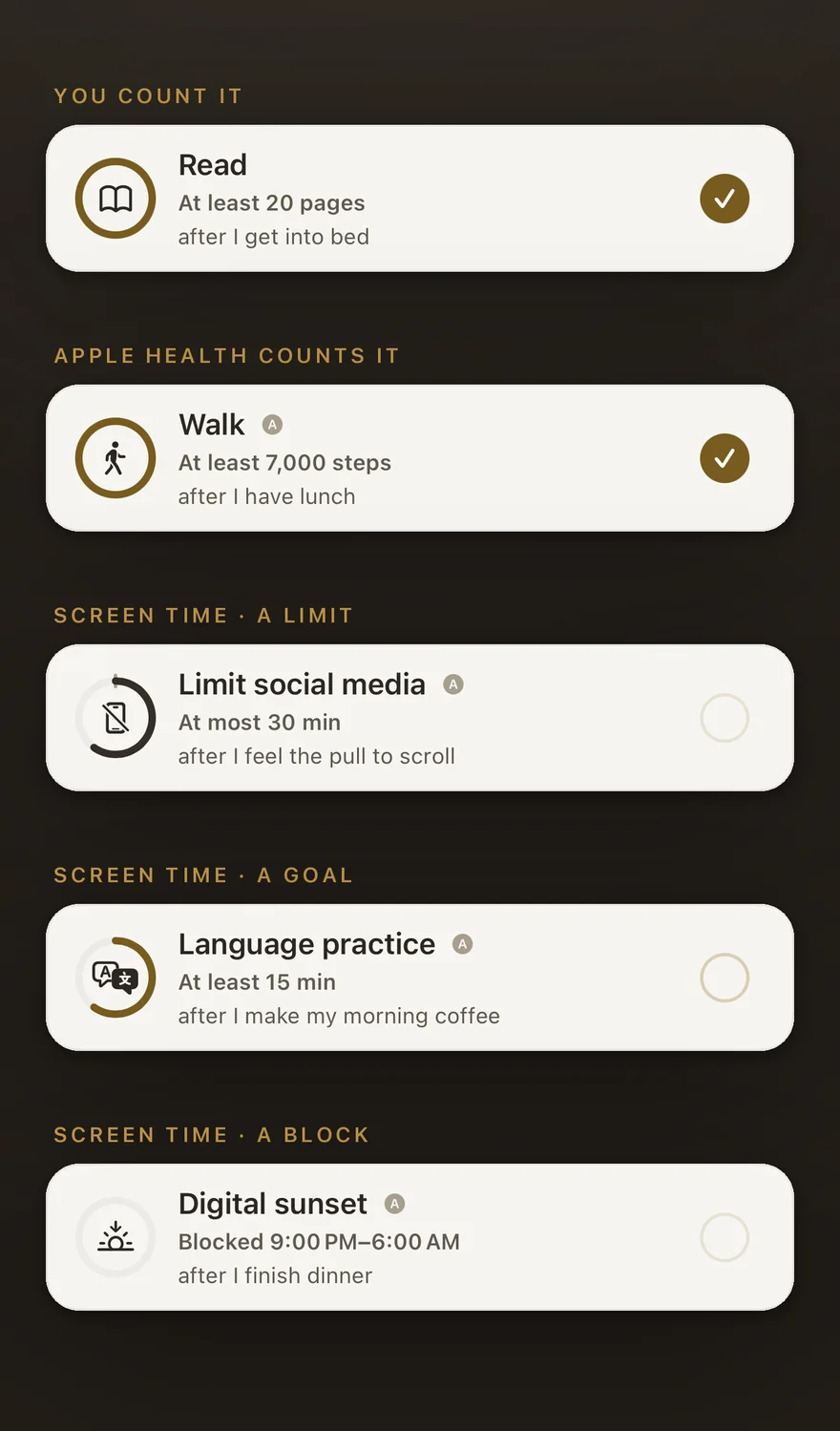
Habits that check themselves off.
Connect a habit to Apple Health or to Screen Time and it completes itself. Steps, workouts, mindful minutes, sleep, water — seventeen Health metrics in all. Screen Time works three ways: a limit that raises a shield when you reach it, a goal of at least so many minutes in the apps you choose, or a block that keeps them shut through a window you set — a digital sunset, say.
Health data syncs late and phones get left on desks, so the record repairs itself — over four weeks for Health, one for Screen Time. You can always mark a day worse than the machine saw; a day it saw you go over a limit stays over.
Yours to correct.
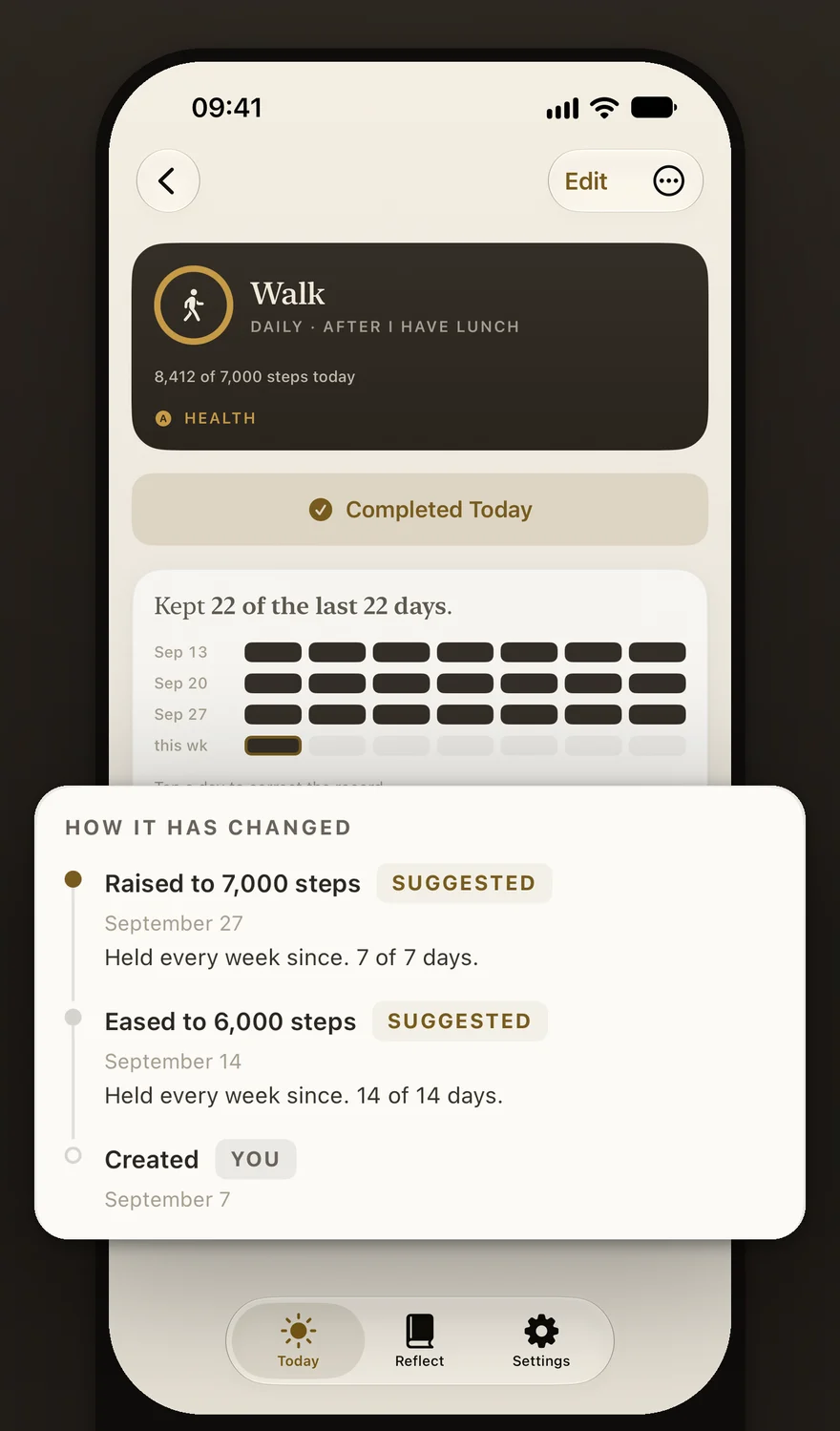
A day you forgot to mark is a day the record got wrong, so every past day is editable from the habit’s own ribbon. Corrections are written as corrections — the app never lets a hand-tick pretend the automation fired.
That matters more here than in a tracker, because the Sunday proposal is derived from the record. If the record lies, the proposal is wrong.
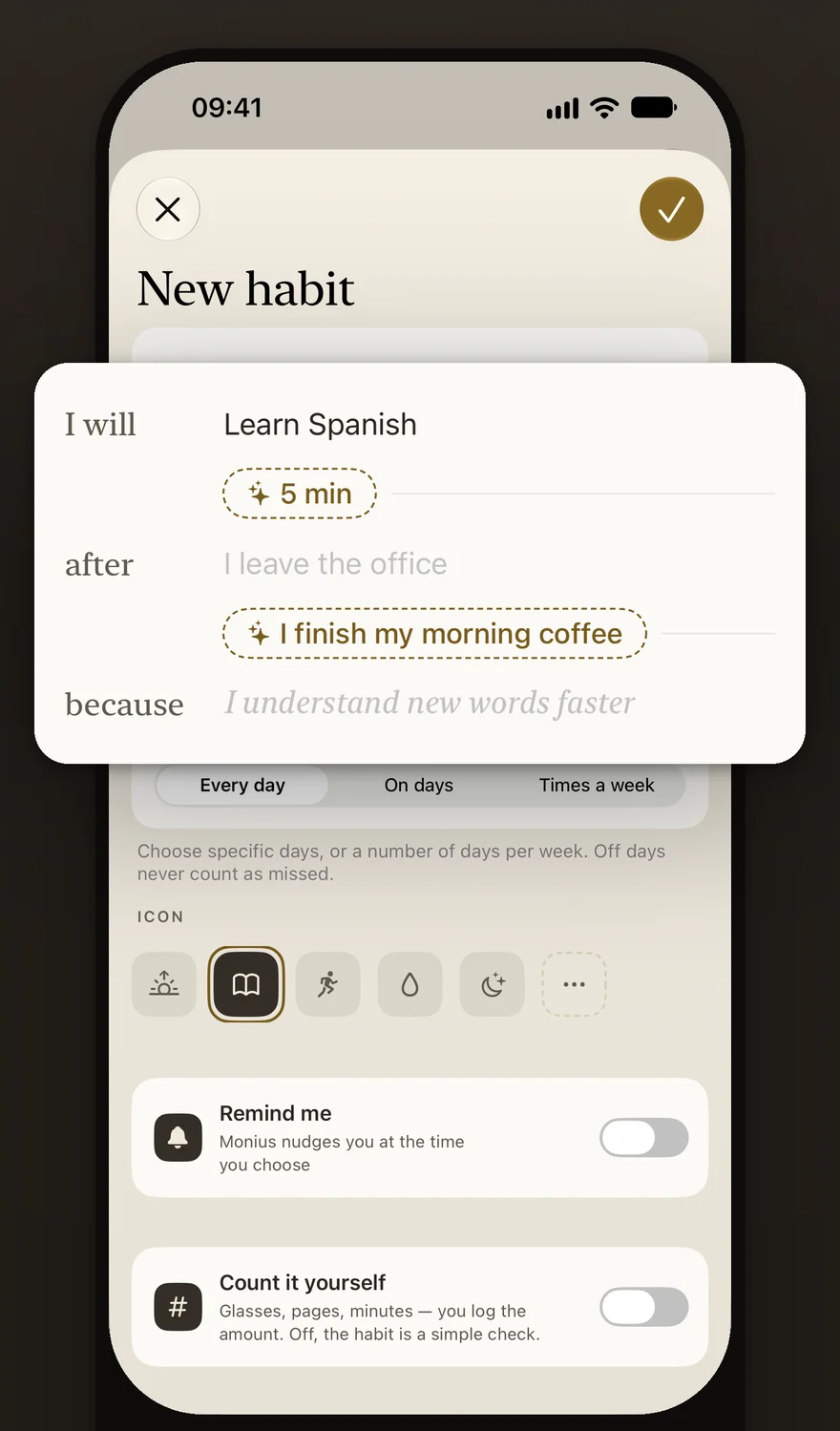
It suggests, and waits for your tap.
Where Monius can save you a decision, it offers one. Two of these run on Apple Intelligence, on the iPhone itself; two are plain rules over your own record. Neither kind sends anything anywhere.
- Apple Intelligence · on device A new habit, in one sentence
- Write “walk 7,000 steps” and the form fills in the amount and offers Apple Health to count it. Write “learn Spanish” and it suggests a small first size — five minutes — and a moment to follow, like after your morning coffee. Each is one tap to take, and the reason stays yours to write.
- Apple Intelligence · on device A quote, explained
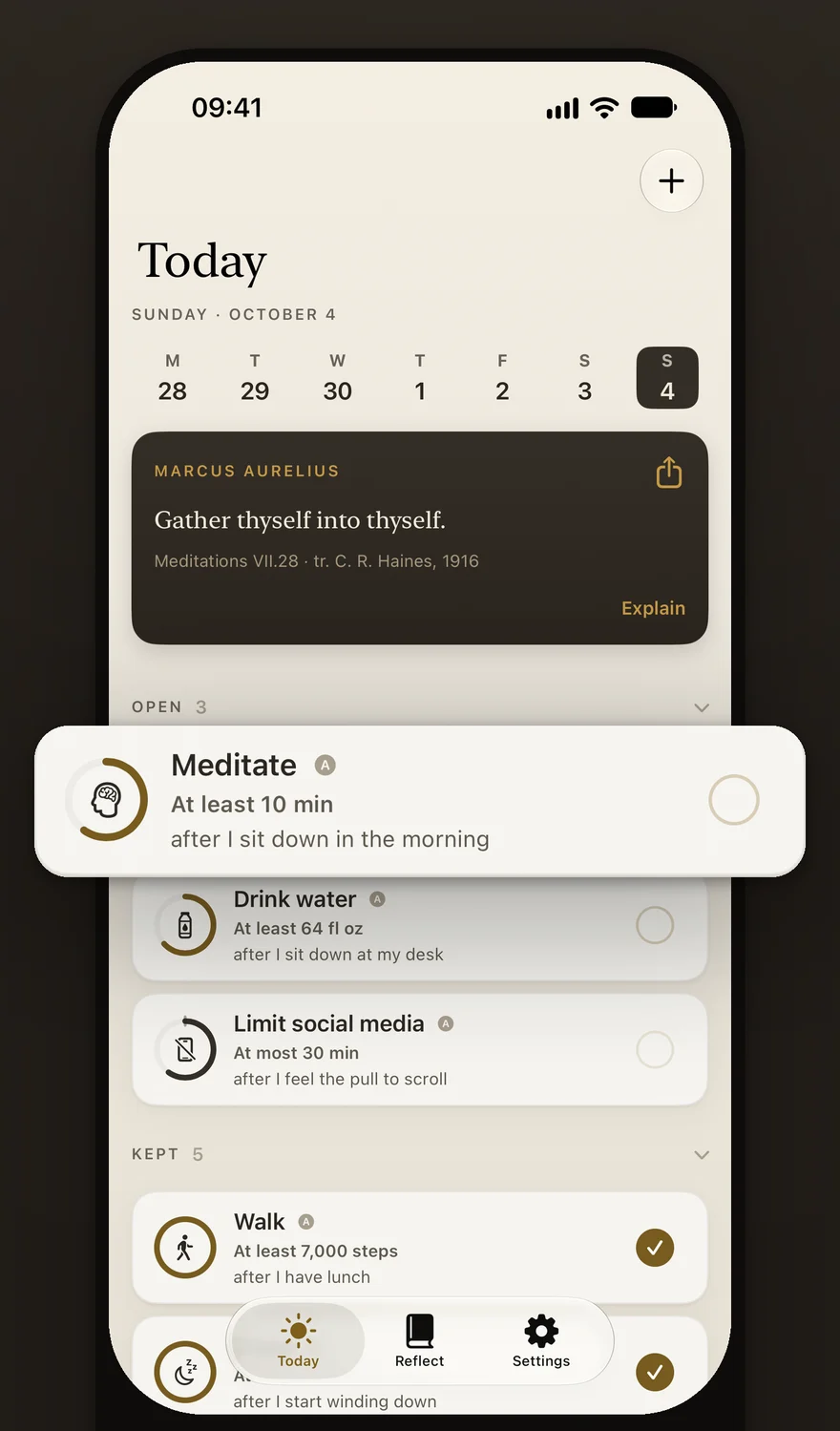
- Each day’s line opens Today with its source and translator named. Tap Explain and it is put in plain words.
- Your Health data From your Health record
- When you add a habit, Monius shows what Health says you already do — 8,000 steps on six days of seven, say — with the goal filled in. At most two a week.
- Your record The Sunday proposal
- Not a model’s guess. The same rules read the same record the same way every week, so a proposal can always say why.
The Apple Intelligence features need an iPhone with Apple Intelligence turned on, in a language it speaks. The suggested size and moment appear when Monius runs in English. Without any of it, everything else works as before.
Nothing leaves your iPhone.
Monius has no account and no server. There is nothing to sign up for, because there is nowhere to sign up to. Your habits, your record and your reasons live on your device, and sync between your own devices through your private iCloud — which Transcendent Creations cannot read.
Health data is read, never written. Monius asks only for the metrics your habits actually use, and it does not add or change anything in Apple Health. Screen-time usage is measured by iOS itself and never handed to the app as browsable data.
There is no analytics SDK in the app, no advertising identifier, no third-party tracker, and no crash reporter that ships your data anywhere.
Try it for a week. Then pay once.
Monius is a one-time purchase. No subscription, no tiers, no upsell inside the app. The trial runs six to twelve days — always long enough to include the Sunday that brings your first proposals — and ends on the Monday after. The review is the thing worth deciding about, and you should see it before you pay for it.
Prices vary by storefront. The App Store shows yours.
Asked before downloading.
- Is there a subscription?
- No. Monius is one payment, yours forever. A trial of six to twelve days runs first — long enough for your first Sunday review — and ends on the Monday after.
- Does it work with Apple Health?
- Yes. A habit can complete itself from seventeen Health metrics — steps, workouts, mindful minutes, sleep, water and more. Health is read, never written.
- Can it limit Screen Time?
- Yes. A Screen Time habit can be a daily limit — iOS raises a shield when you reach it — a goal of at least so many minutes, or a block that keeps chosen apps shut through a window you set. Usage is measured by iOS and never handed to the app as browsable data.
- Are there widgets?
- Yes, on the Home and Lock Screen: all of today, one habit, or up to four you choose, and a daily quote. They show progress; you mark days in the app.
- Does it sync between my iPhones?
- Through your own private iCloud, which Transcendent Creations cannot read. There is no account and no server.
- Is Monius a stoic app?
- In its restraint. A line from a public-domain text opens each day — Seneca and Marcus Aurelius, but also Thoreau, Emerson or Confucius — the Sunday review judges outcomes and never the person, and a missed day is called unmarked. Nothing in it preaches.
- Which iPhones and languages?
- Any iPhone on iOS 26 or later, in English, German and Czech.
- Does it need Apple Intelligence?
- No. Everything works without it. With Apple Intelligence turned on, the new-habit form can also suggest a first size and a moment — when Monius runs in English — and a quote can be put in plain words. Both run on the iPhone itself.
Made by Transcendent Creations.
A small independent iOS studio. If something is wrong with the app, you are emailing the person who wrote it.